
Meet the Grantee: Dr. Habib Sani Usman
Cross-cutting legal issues in the German-Nigerian green hydrogen partnership.
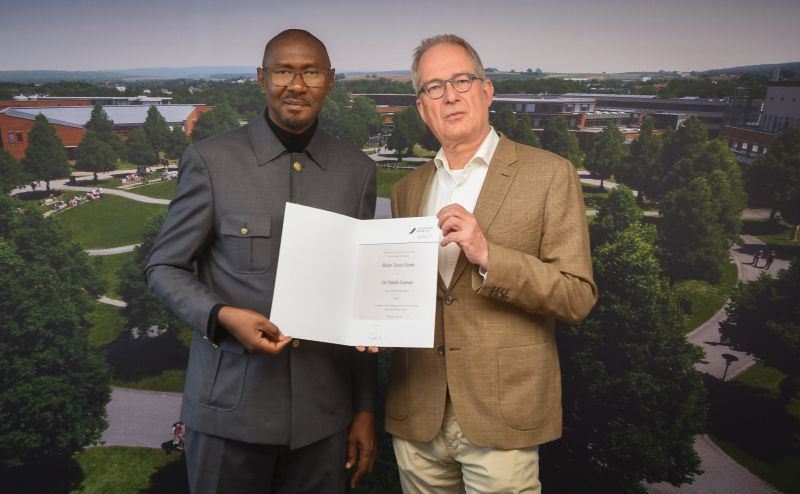
Short Term Grantee Dr Habib Sani Usman explores how law can strengthen the German–Nigerian green hydrogen partnership, and why Bayreuth’s reliable power supply inspired his research. He also shares why he sees international mobility as “a two-way process”.
If you had to explain the research project of your Short Term Grant to the person you metin the elevator, how would you describe it?
Habib Sani Usman: My research looks at how law can help to strengthen the Germany–Nigeria partnership on Green Hydrogen (GH2). Already, Germany and the European Union have to some extent, a developed legal and policy frameworks that support the production, investment, and use of Green Hydrogen. I want to examine these frameworks and identify lessons that Nigeria can adapt to its own context. Ultimately, the project explores how a dedicated and effective legal framework could help Nigeria attract investment, support innovation, ensure environmental sustainability, and make its Green Hydrogen sector more competitive and sustainable.
Was there a special moment in your life that made you decide for your research focus?
Habib Sani Usman: I was struck by the reliability of the electricity supply throughout my stay in Bayreuth from October to Dec. 2024 as a DAAD-sponsored visiting scholar at the Chair of African Legal Studies, University of Bayreuth. This experience made me curious about Germany’s energy system and how the country manages to maintain such a reliable supply. As I explored Germany’s energy mix, I discovered its growing reliance on diverse renewable energy sources, and GH2 particularly caught my attention.I began to ask myself whether Nigeria could harness the same opportunity, especially given the existing GH2 cooperation between Germany and Nigeria. As a lawyer with a strong interest in sustainable development, I realised that this was not only an important energy question but also a legal and policy challenge. I became interested in exploring how law can support and strengthen the German-Nigerian GH2 partnership. My experience in Bayreuth therefore became the turning point that connected my personal experience, legal scholarship, and interest in sustainable development—and ultimately shaped the focus of my research under the auspices of the Bayreuth Humboldt Centre.
What is in your opinion the future of your field(s)? In what way can research in your field(s)contribute to meeting the urgent challenges of our time?
Habib Sani Usman: The future of GH2 lies not only in technological innovation but also in developing effective legal and regulatory frameworks to govern its production, transportation, trade, and use. Both the technology and its governance are still evolving, not only in Africa but also in Europe. This is an opportunity for researchers, particularly in developing countries such as Nigeria, to help shape appropriate legal frameworks. GH2 has considerable potential to support the transition to cleaner energy, reduce carbon emissions, strengthen energy security, and contribute to the Paris Agreement’s net-zero ambitions and the United Nations SDGs, particularly SDG 13 on climate action. My research therefore asks an important question: how can law and policy create an enabling environment for GH2 while ensuring that its development is sustainable, inclusive, and beneficial to both producers and communities?I see my field contributing to one of the most urgent challenges of our time—how to meet growing energy demands while addressing climate change. Effective regulation can help turn GH2 from a promising technology into a practical and sustainable component of the global energy transition.
What does international research mobility in today's world mean to you?
Habib Sani Usman: To me, international research mobility means going beyond the boundaries of my own academic environment to learn, exchange ideas, and build meaningful research relationships. It allows me to engage with scholars from different disciplines and countries, gain new perspectives, and understand how similar challenges are approached in different legal and policy contexts. It also creates opportunities for long-term research collaboration, knowledge exchange, and joint publications. More importantly, I see international mobility as a two-way process: I am not only coming to learn from others, but also bringing my own experience and perspectives from Nigeria and Africa to contribute to the international academic community. In today’s interconnected world, I believe this exchange is essential for producing research that is both locally relevant and globally meaningful.
What was your personal experience during your stay, e.g. what did you like best about the University/
the city of Bayreuth, what surprised you…? What is your favourite spot in Bayreuth or the region?
Habib Sani Usman: My stay at the University of Bayreuth was a very enriching experience, both academically and personally. I was particularly impressed by the German teaching and learning approach, especially the distinctive way the law programme combines rigorous academic training with practical perspectives. I also found the University of Bayreuth remarkable because of its beautiful campus and the way it is naturally integrated into the city.Beyond the university, I really enjoyed exploring Bayreuth. The Iwalewahaus, the city centre, the Rotmain Centre, and, above all, the Margravial Opera House and the Wagner sites made the city very special for me. What surprised me most was how Bayreuth combines a rich cultural and historical heritage with a calm and welcoming atmosphere. I would say that Bayreuth has become my favourite city in Bavaria because it gave me not only an excellent academic experience but also a strong sense of connection with the city and its people.
What were your expectations when you applied for the Grant? Did you have specific goals in mind, something you were hoping to achieve?
Habib Sani Usman: When I applied for the Grant, I was certainly hopeful that my application would be successful. My confidence came partly from the strong interest my host showed in my research topic and from our discussions about its relevance to the growing German-Nigerian cooperation in GH2. I also had a broader expectation: to use the opportunity not only to advance the research itself, but also to strengthen the academic relationship and collaboration I had already developed with the University of Bayreuth.I hoped to gain new perspectives, engage with scholars working in related areas, and develop a research project that could make a meaningful contribution to the legal and policy discussion on Green Hydrogen in Nigeria. Looking back, I believe the Grant offered much more than I initially expected—it provided an opportunity to deepen existing academic ties, build new collaborations, and position my research within a broader international context.
If you could choose a famous researcher or scientist to have dinner with, who would it be?
Habib Sani Usman: If I could choose a researcher to have dinner with, I would choose Prof. Dr. Jörg Gundel from the University of Bayreuth. As Managing Director of the Research Centre for German and European Energy Law, his expertise is particularly relevant to my research on the legal and regulatory dimensions of GH2.What I would value most about such a conversation would be the opportunity to hear his perspective on how European energy law is evolving in response to the energy transition and how some of those experiences could inform the development of an appropriate regulatory framework for GH2 in Nigeria. I would also be interested in discussing the future of German-Nigerian energy cooperation and the role that legal scholarship can play in making that partnership more effective and sustainable.For me, it would not simply be a dinner with a distinguished scholar; it would be an opportunity to exchange ideas with someone whose expertise directly intersects with the research question I am currently exploring.
Have you noticed any differences or similarities between UBT and your home university?
Habib Sani Usman: UBT is different from my home university (the American Univ. of Nigeria -AUN) for, its an open and a city-integrated campus. UBT is a university without rigid physical boundaries, yet accessible to students, staff, and the wider community, without losing a sense of security. I also noticed the relatively smaller class sizes, the flexibility in teaching arrangements, and the structured lecture timetable at UBT. I found out that lunchtime seemed to be a shared routine for both students and staff, which created a sense of community. At the same time, both UBT and AUN follow broadly similar academic calendars, with semesters beginning and ending around comparable periods, and they organise academic activities and events in similar ways. There are also similarities in university governance, as the leadership structures, titles, and functions are broadly comparable.Overall, the experience showed me that although universities may operate within different national and institutional contexts, they share many common values and structures. That combination of differences and similarities made my experience at UBT both interesting and intellectually enriching.
The Grantee
Dr Habib Sani Usman is a legal scholar whose research sits at the intersection of law, technology, environmental governance, and sustainable development. He holds a Doctorate in International Aspects of Law from North-West University, South Africa, and an LLM in Law and Technology from Tilburg University, the Netherlands. He is an Assistant Professor at the School of Law, American University of Nigeria, where he teaches Environmental Law, Medical Law and Bioethics, Constitutional Law, and the Application of Computers to Legal Studies. His research examines how legal and regulatory frameworks can facilitate technological innovation while addressing emerging environmental and societal challenges. His current work focuses particularly on Green Hydrogen governance, climate change, digital and precision agriculture, and sustainable development, with a strong interest in comparative European-African legal perspectives and the development of effective regulatory frameworks for Nigeria and other developing countries.