
Meet the Fellow: Nichola Strandberg
Reconstructing past abundances of plant taxa over time using sedaDNA – an explorational approach from Northern Fennoscandia
Short Term Grantee Dr Nichola Strandberg reads the history of ecosystems in lake sediments. Find out how ancient DNA can help shape today's conservation strategies, and why Bayreuth surprised her with its nature.
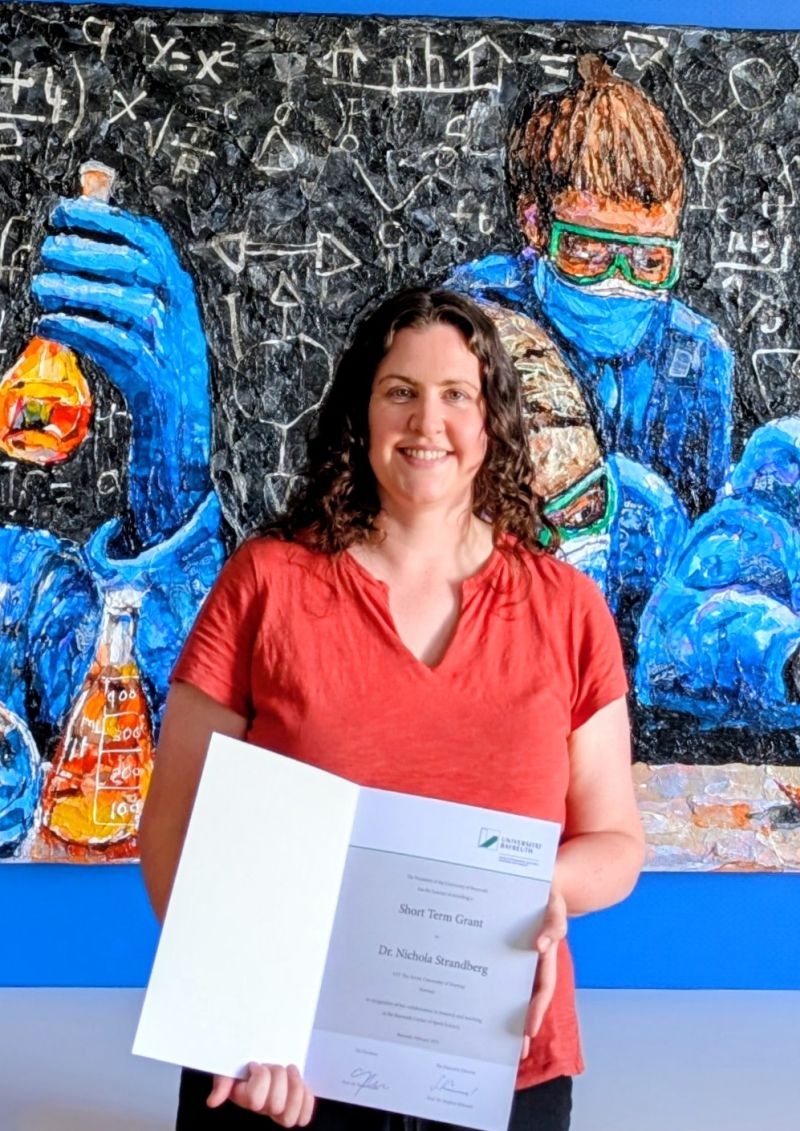
Dr. Nichola Strandberg with her certificate from the Bayreuth Humboldt Centre
If you had to explain the research project of your Short Term Grant to the person you metin the elevator, how would you describe it?
Nichola Strandberg: To understand why today’s plants and animals occur where they do, we need to understand how ecosystems have changed over time. My research uses fossil pollen grains and ancient sedimentary DNA preserved in lake sediments to reconstruct which plants and animals lived in an area over the past several thousand years. We then investigate the forces that shaped their populations and distributions, such as climate change and human activity. This long-term perspective can help us better anticipate how ecosystems may respond to environmental change in the future. Lakes are particularly valuable for this work because their sediments accumulate over time, creating a natural archive of past environments.
Was there a special moment in your life that made you decide for your research focus?
Nichola Strandberg: I became interested in palaeoecology during my undergraduate degree in Geography, following an excursion to Holcroft Moss in Cheshire, and decided I wanted to pursue it further at master’s level.
What is in your opinion the future of your field, and in what way can research in your field contribute to meeting the urgent challenges of our time?
Nichola Strandberg: I think palaeoecologists will increasingly collaborate with contemporary ecologists, conservation practitioners, and policymakers. Palaeoecology provides a long-term perspective that is often missing from studies of present-day ecosystems. For example, it can help identify the composition of ecosystems before major human changes, distinguish native from introduced species, and reveal how ecosystems responded to past climatic changes. This evidence can support more informed conservation goals, restoration strategies, and environmental policies.
What does international research mobility mean to you?
Nichola Strandberg: For me, international research mobility means unlocking potential and enabling meaningful collaboration across borders. Strong international links can only benefit science, particularly because environmental challenges such as climate change and biodiversity loss do not stop at national borders. Working with colleagues from different institutions and backgrounds brings together complementary expertise, resources, ideas, and perspectives.
What was your personal experience during your stay, e.g. what did you like best about the University / the city of Bayreuth, what surprised you…? What is your favourite spot in Bayreuth or the region?
Nichola Strandberg: I was surprised by how green and leafy Bayreuth is, and by the amount of nature so close to the city. I saw a cuckoo, deer, a hare, and even signs of a beaver habitat. My favourite spot is the Kreuzsteinbad outdoor swimming pool, my son loved playing in the water. The research stay has also been very rewarding on a personal level. It has sparked new research ideas and opened up exciting possibilities for future work.
What were your expectations when you applied for the Grant? Did you have specific goals in mind, something you were hoping to achieve?
Nichola Strandberg: My main hope was to strengthen the research ties between my group in Tromsø and colleagues in Bayreuth, while also gaining a fresh perspective on my own research. I was particularly looking forward to discussing the future direction of our research area and identifying opportunities for longer-term collaboration. I have been very inspired by the researchers here in Bayreuth, particularly Prof. Manuel Steinbauer and Dr. Anna Walentowitz. I greatly admire their enthusiasm for nature and their ambition to continually improve research approaches and strategies.
If you could choose a famous researcher or scientist to have dinner with, who would it be?
Nichola Strandberg: I think I would choose an astronaut. I’d be interested to get their perspective on seeing the Earth from space as one whole system.
Have you noticed any differences or similarities between UBT and your home university?
Nichola Strandberg: University life seems to play an important role in both Bayreuth and Tromsø. The cities are of a similar size and both have relatively large student populations, which gives them a lively and international atmosphere. In both places, the university is closely connected to the identity and daily life of the city.
The Grantee
Dr Nichola Strandberg is fascinated by long-term vegetation dynamics and the environmental forces that drive them. Her research explores past human impacts as well as the effects of natural processes, including volcanic eruptions, sea-level change, and climatic variability. Her work has primarily used subfossil pollen grains to investigate vegetation change over millennial timescales in Scandinavia, the Mediterranean, and several South Pacific islands. More recently, her focus has shifted towards exploring the potential of sedimentary ancient DNA (sedaDNA) to improve our understanding of past ecosystems. She has recently investigated how effectively sedaDNA methods detect plant diversity in environmental samples and assessing potential methodological biases in these approaches.