
Meet the Fellow: Professor Markus Stock
Medieval Undergrounds: Subterranean Entanglements in Medieval and Early Modern German Literature
During his Fellowship at the Chair of German Medieval Studies, Prof. Dr. Markus Stock explored how medieval and early modern texts shaped—and were shaped by—human engagement with underground spaces such as caves, mines, and grottoes. His work uncovers the narratives, knowledge systems, and early resource practices that influenced pre‑industrial societies. In our interview, he reflects on the role of the humanities today and the importance of international collaboration in addressing complex cultural questions.
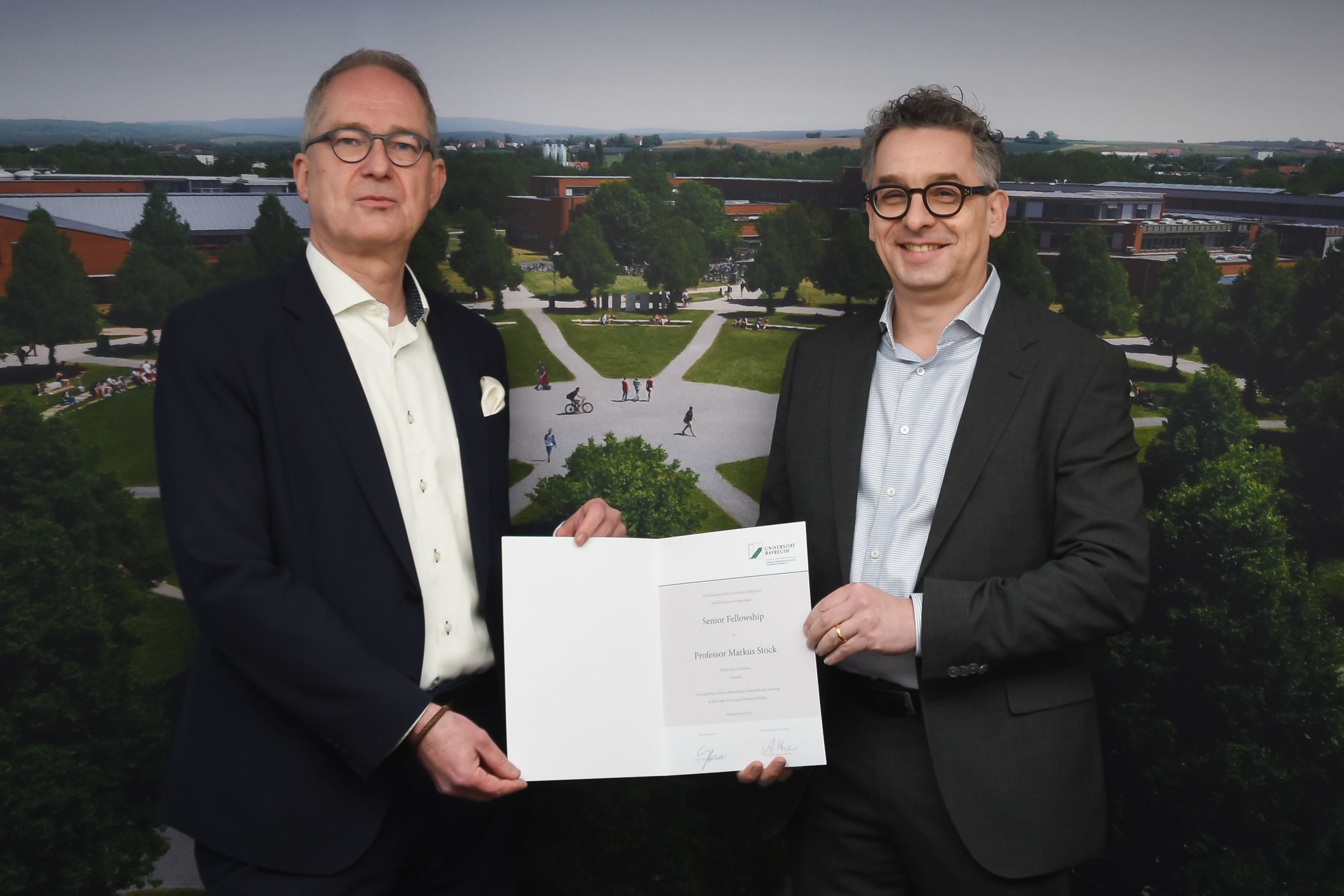
Professor Stock and Professor Leible, President of the University of Bayreuth
If you had to explain the research project of your Fellowship to the person you metin the elevator, how would you describe it?
Markus Stock: We study the ways in which literary and other texts shape and are shaped by the engagement with underground spaces, such as caves, grottoes, or mines in medieval and early modern Germany. We analyze information from a variety of medieval and early modern sources in German and Latin (literary and legendary storytelling, songs, as well as treatises, sermons, mining manuals, and other non-literary sources), in order to understand pre-industrial realities and imaginations regarding undergrounds, the resources they hold, and the beliefs and knowledge guiding early resource extraction through mining.
Was there a special moment in your life that made you decide for your research focus?
MS: I cannot pin down the decision for my research focus to a special moment, but certainly to special periods of my life. I was very much influenced by my positive experiences as a BA student which fostered a fascination for medieval literatures. Certainly, my training as a PhD student shaped my path into studying the power of storytelling in medieval cultures. I can name the moment at which I decided on my current research focus on undergrounds and resource extraction in medieval and early modern Germany: It was a visit to Bochum's Mining Museum, where I saw some stunning exhibits regarding early modern mining and had a long chat over coffee with an expert historian from the museum's research department. I came away from this amazing day with a clear sense that this would be my next big project.
What is in your opinion the future of your field(s)? In what way can research in your field(s)contribute to meeting the urgent challenges of our time?
MS: I believe the study of cultures, literatures, and storytelling will remain an important part of what universities do. In the future, my field should (and I believe: will) even more forcefully seek interdisciplinary connections. The research on literatures, history, and the humanities in general has a significant role to play in explaining how meaning is created and fostered historically and today. Seeing through constructions of true and false narratives around the self-definition of communities and societies seems an urgent challenge of our time - and the humanities have the tools to such create and communicate such insights.
What does international research mobility in today's world mean to you?
MS: Boundless international exchange of research ideas coupled with meaningful interdisciplinary collaboration between researchers is the only way to tackle the challenges we are facing today. Mobility can mean many different things and it doesn't always have to imply air travel that is detrimental to our climate. Research mobility can also mean hybrid and online meetings and other forms of remote collaboration. However, it seems important to me that occasionally collaborators need to meet in person to get a sense of each other as a three-dimensional human being. I can say that my current research project would have simply not taken the shape it has without my intensive interaction especially with German colleagues. Programs such as the University of Bayreuth's Humboldt Centre Fellowships are key to fostering the research collaborations needed to formulate relevant answers to complex research questions.
What was your personal experience during your stay?
MS: I had a lovely time in Bayreuth. Attending two performances during the Wagner Festival early on in my fellowship was an absolute delight; so were the memorable hikes in the beautiful 'Franconian Switzerland' region south of Bayreuth. My favourite spots in Bayreuth have become the Hofgarten which I traversed on my walks to campus, and the beautiful Aufsesstal near Bayreuth, where I went on hikes. I also found the Markgraefliches Opernhaus in Bayreuth a stunning historical building, which utterly deserves its status as World Cultural Heritage.