
Meet the Grantee: Prof. Dr. Pablo Silva Ortiz
Transitioning to PtX Technologies in Colombia and Germany: From a technical, economic, and environmental perspective
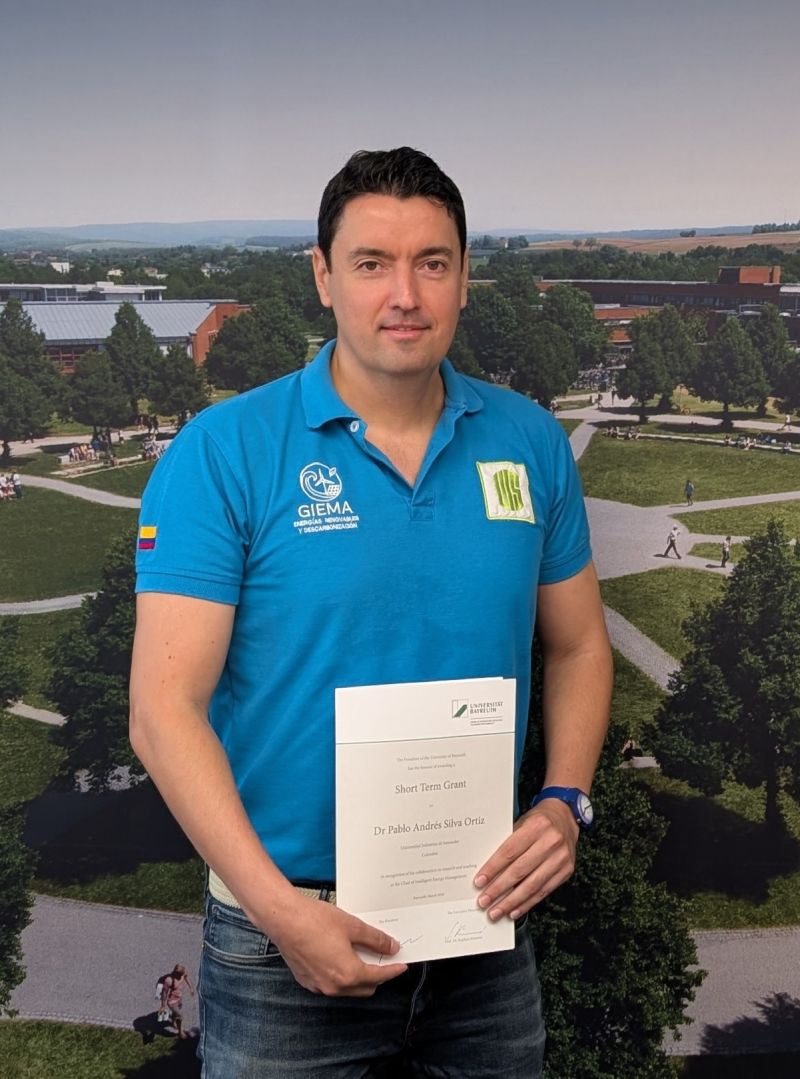
Prof. Dr. Pablo Silva Ortiz
If you had to explain the research project of your Short Term Grant to the person you metin the elevator, how would you describe it?
Pablo Silva Ortiz: My research project focuses on the energy transition from a fossil-fuel-based economy to a bioeconomy, promoting the adoption of low-carbon technologies through the implementation of renewable energy and energy-efficiency projects.
Elevator pitch paragraph: We're all trying to move away from fossil fuels, and my research focuses on how to make that transition successful. Specifically, I investigate how we can shift from an oil-and-gas economy to a bioeconomy, where energy is sourced from renewables and, waste is used as feedstock. I analyze the practical steps needed to implement low-carbon technologies and energy efficiency projects in real-world settings. This includes examining technical challenges, economic barriers, and how to design projects that communities and industries will actually adopt. Essentially, I'm working on creating a practical roadmap for the energy transition—not just identifying the destination, but also outlining how we can get there.
What is in your opinion the future of your field(s)? In what way can research in your field(s)contribute to meeting the urgent challenges of our time?
Pablo Silva Ortiz: The future of the energy sector goes beyond simply replacing fossil fuels with renewable sources. Wind and solar energy alone cannot effectively decarbonize heavy industries, shipping, or aviation in the necessary timeframe. The real advancement lies in establishing a circular bioeconomy that transforms waste into valuable resources, integrates bioenergy with carbon capture, and creates resilient systems. This approach directly supports the Sustainable Development Goals (SDGs), particularly SDG 7 (clean energy), SDG 9 (innovation), SDG 12 (responsible production), and SDG 13 (climate action). However, there is an important challenge: research indicates that current bioeconomy strategies often overlook social equity and can lead to trade-offs, such as competition for land between bioenergy and food production or potential biodiversity loss. Therefore, my research aims to contribute not only in terms of technology but also in designing energy transition projects that are fair, inclusive, and sensitive to local contexts.
What does international research mobility in today's world mean to you?
Pablo Silva Ortiz: In my opinion, research mobility encompasses more than just short-term fellowships. It extends to include student supervision, shared infrastructure, and virtual collaboration tools that allow for ongoing collaboration across borders. On a personal and professional level, mobility transforms the way researchers think by exposing them to diverse methodologies, research cultures, and problem-solving approaches. Lastly, research mobility also promotes equity and contributes to global knowledge production.
If you could choose a famous researcher or scientist to have dinner with, who would it be?
Pablo Silva Ortiz: I would choose Rudolf Diesel. During dinner, I would first ask him what really happened on that cross-Channel voyage in 1913. Then, I would quickly shift to talk about his engine, originally designed to run on peanut oil, which is now the backbone of the diesel/biodiesel revolution, demonstrating that his vision was a century ahead of its time. I would explore his idealistic belief that his efficient engine would democratize power and free small artisans from industrial monopolies. Additionally, I would ask how he reconciles that ideal with the engine's use in submarines, warships, and global logistics.
Have you noticed any differences or similarities between UBT and your home university?
Pablo Silva Ortiz: Currently, I am an assistant professor at the Universidad Industrial de Santander (UIS) in Bucaramanga, Colombia. Regarding similarities, I believe that both institutions set disciplinary/interdisciplinary priorities and foster the comprehensive development of their students through modern infrastructure, highly qualified staff, and ongoing opportunities for personal and professional growth. I would also like to highlight the green campuses/sustainability commitment of both institutions, which offer an eco-friendly environment while studying or working. About differences, UIS has a total enrollment of about 22,000 to 23,000 students. From what I know, UBT has around 12,000 students enrolled. This also represents a difference in the programs offered at the bachelor's and postgraduate levels.
The Grantee
Dr. PABLO SILVA ORTIZ is an Energy Engineer with an interdisciplinary background in energy resources management and energy conversion technologies. He completed his PhD in Mechanical Engineering at the Polytechnic School of the Universidade of São Paulo (Brazil) in 2016, in collaboration with École Polytechnique Fédérale de Lausanne (Switzerland). Then, Dr. PABLO was working on the valorization of feedstocks and co-products involved in biomass conversion at the Universidade Estadual de Campinas (Brazil), jointly with Delft University of Technology (the Netherlands). In 2019, He was also a project collaborator on IEA Task 39, working on analyzing biofuel production in non-IEA emerging economies. From 2021 to 2022, he was acting as an energy consultant at the E+ Energy Transition Institute. From 2023 to 2024, he worked on the environmental performance of SAF pathways at the Technical University of Munich (Germany). In August 2024, He starts a position as an assistant professor at the Universidad Industrial de Santander (Colombia), focusing on accelerating the deep energy transition through the development of low-carbon technologies and on connecting the industry and academic sectors.