
Meet the Grantee: Dr. Ping Liu
Trade Openness and Modern Industrialization in China: A County-Level Econometric Study of Treaty Port Openings (1840–1930)
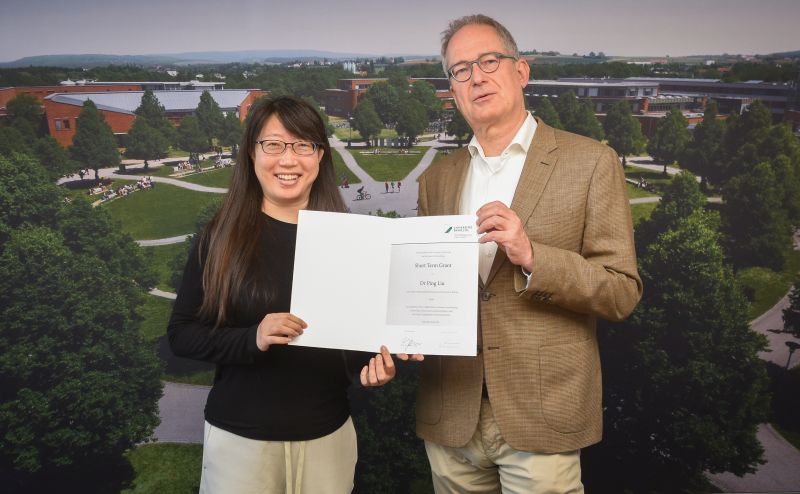
Dr. Ping Liu and Prof. Dr. Stefan Leible, President of the University of Bayreuth
If you had to explain the research project of your Short Term Grant to the person you metin the elevator, how would you describe it?
Ping Liu: Inspired by Pomeranz’s Great Divergence thesis, my research asks whether external linkages played a role in China’s modern industrialization. While Europe gained access to overseas resources and markets through active colonial expansion, China was forcibly integrated into the global economy through the treaty port system after the First Opium War of 1840–1842.
I study how this form of “external linkage” affected China’s early industrial development. Using quantitative historical evidence at the county level, I find that treaty ports tended to attract modern firms, capital, and labor, thereby promoting industrial activity in those areas.
Overall, the project suggests that China’s forced integration into the global economy served as an important channel through which modern industry was introduced, albeit in a very different institutional context from that of Europe.
What does international research mobility in today's world mean to you?
Ping Liu: International research mobility today means more than physical travel between institutions. For me, it represents the opportunity to engage in sustained academic exchange across different research environments, intellectual traditions, and methodological approaches.
It allows researchers to gain new perspectives, challenge established assumptions, and situate their own work within broader international debates. At the same time, mobility facilitates the development of long-term academic networks that can support collaborative research beyond the duration of a single stay.
In this sense, international mobility is not only about individual research progress, but also about contributing to and participating in a shared global academic community.
What was your personal experience during your stay?
Ping Liu: I would like to thank my host and the Bayreuth Humboldt Centre for their generous support and excellent organization, which made my stay in Bayreuth a very pleasant and rewarding experience.
What I particularly appreciated about the University of Bayreuth was its friendly and collaborative research environment. It was very easy to interact with faculty members and discuss research ideas in an open and welcoming atmosphere.
I was also pleasantly surprised by the balance between academic life and quality of life. Bayreuth is a relatively small city, but it offers everything needed for daily life while remaining quiet and comfortable. Compared with larger cities, it was much easier to focus on research without distractions.
Overall, I greatly appreciated the combination of an excellent academic environment and a very pleasant living atmosphere.
What were your expectations when you applied for the Grant? Did you have specific goals in mind, something you were hoping to achieve?
Ping Liu: My main expectation was to engage in academic exchange and improve my research through discussions with scholars in my field. I aimed to receive feedback on my project, gain new perspectives and methodological insights, and develop international research collaborations. At the same time, I hoped to share perspectives from Chinese economic history and my ongoing research in these discussions. The grant provided an excellent opportunity to achieve these goals and helped me further develop my research agenda.
If you could choose a famous researcher or scientist to have dinner with, who would it be?
Ping Liu: If I could have dinner with one scholar, I would choose Kenneth Pomeranz. His Great Divergence thesis has strongly influenced my research, particularly his argument that access to external resources and markets helped Europe overcome key constraints during industrialization.
I would like to discuss whether “external compensation” should be understood more broadly as access to external linkages that relax domestic development constraints, rather than being limited to colonial expansion. My research can be seen as an attempt to explore this question through the historical experience of China’s treaty ports.