
Meet the Fellow: Dr. Ezgi Güler Küspert
The Case of Forced Syrian Migration in Turkey: Changing Migration Governance and Everyday Realities in Istanbul
Dr. Ezgi Güler, a scholar of migration and border studies from Sabancı University in Istanbul, reflects on the value of international research mobility and the complexities of studying border regimes. She highlights how her Humboldt Centre fellowship, hosted by Dr Viola Castellano, Chair of Social and Cultural Anthropology, provided an enriching space for exchange, collaboration, and new perspectives.
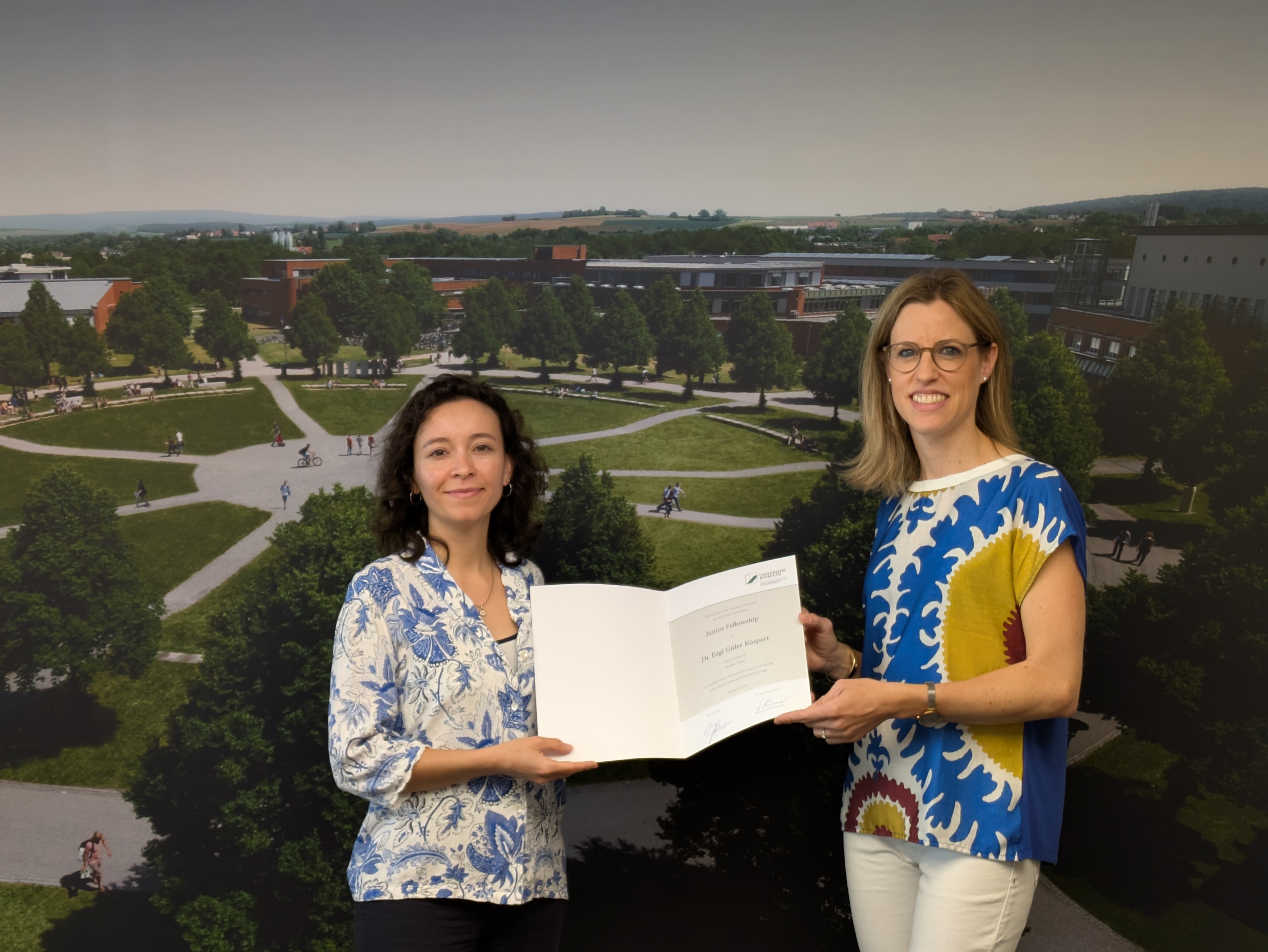
Dr. Ezgi Güler and Susanne Lopez
If you had to explain the research project of your Fellowship to the person you metin the elevator, how would you describe it?
Ezgi Güler: During my fellowship, and in the period that followed, I collaborated with Dr. Viola Castellano at the intersection of critical border studies and ethnographic research methods. Our work focused on the ethical and political entanglements of researching border regimes, particularly for scholars whose lives are connected to these contexts. I built on my fieldwork examining how governmental approaches to forced migration shape the living conditions and everyday struggles of Syrian refugees in Turkey. A joint research output resulting from this collaboration draws on our (auto)ethnographic engagements to explore how knowledge production on borders is shaped by researchers’ positions within both externalized (e.g., Turkey) and internalized (e.g., Italy) EU border regimes, and how such positioning can inform research practices as a form of solidarity.
What does international research mobility in today's world mean to you?
EG: For me, international research mobility today is about far more than simply working in different academic or cultural contexts. It is about building intellectual connections and political alliances in an increasingly hostile world. Through these connections, you come to recognize shared sensibilities, concerns, and impulses with scholars across the globe, which is both grounding and inspiring. Also, being physically present with other scholars enables spontaneous interactions, chance conversations, and unplanned collaborations that are difficult to replicate online. These encounters make the research process, and academic life more broadly, richer and more rewarding.
What was your personal experience during your stay?
EG: During my stay in Bayreuth, I truly enjoyed the combination of cultural vibrancy and natural beauty. Spending the summer in Bayreuth allowed me to experience festivals and events such as the Bayreuther Bürgerfest, the African Festival, and, of course, Pride. Coming from Istanbul, I especially appreciated being so close to nature. Hiking and cycling in the surrounding areas was a wonderful way to recharge and enjoy my time.
What were your expectations when you applied for the Fellowship?
Did you have specific goals in mind, something you were hoping to achieve?
EG: Having completed my PhD focusing on gender and sexuality, I gradually expanded my research interests to migration during my postdoctoral research. When I applied for the Humboldt Fellowship, I hoped that through independent and collaborative work in this field, I could further establish myself as a researcher with expertise in forced migration and border studies.
Have you noticed any differences or similarities between UBT and your home university?
EG: I am accustomed to campus-style universities, where everything is easily accessible and the environment is lively. In this sense, Bayreuth felt very comfortable and familiar. I also really enjoyed having the pool right next door!
The Fellow
Ezgi Güler received her Ph.D. from the European University Institute in Florence and subsequently worked as an adjunct lecturer at the Technical University of Darmstadt and as a postdoctoral researcher at Sabanci University in Istanbul. Her research interests include urban marginality and politics, gender and sexuality, migration and borders, and ethnography and qualitative research methods. Her recent work has appeared in The ANNALS of the American Academy of Political and Social Science, the Journal of Middle East Women’s Studies, and various edited volumes.