
Meet the Fellow: Dr. Ketaki Belsare
De Novo Computational Design of minimal Lytic Polysaccharide Monooxygenase
Our Grantee, Dr. Ketaki Belsare combines enzyme engineering and computational protein design to create new enzymes that can break down natural and synthetic polymers, from cellulose to plastics. During her stay in Bayreuth, she and her host, Prof. Dr. Birte Höcker, worked on designing a minimal copper-containing enzyme from scratch, laying the foundation for a long-term Indo-German collaboration.
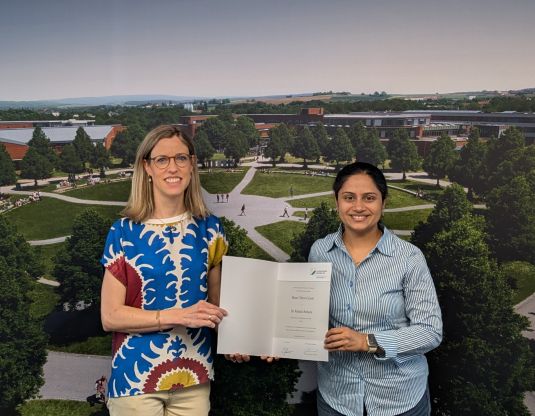
Susanne Lopez (left), Managing Director of the Humboldt Centre, with Dr. Ketaki Belsare (right).
If you had to explain the research project of your Short Term Grant to the person you met in the elevator, how would you describe it?
Ketaki Belsare: We are trying to build an enzyme from scratch that can help break down natural polymeric materials like chitin and cellulose. Nature already has enzymes called Lytic Polysaccharide Mono-oxygenases (LPMOs) that can do this using a single copper atom. They are powerful, but they are relatively large and can be unstable. We want to use computer-based protein design to build a much smaller version containing only the essential machinery needed for the chemistry. If successful, this could give us a simple and potentially more robust platform for designing enzymes that can break down natural and synthetic polymers, particularly plastics.
What is in your opinion the future of your field, and in what way can research in your field contribute to meeting the urgent challenges of our time?
Ketaki Belsare: I believe the future of protein engineering lies increasingly in the integration of experimental biology, computational modelling, artificial intelligence and synthetic biology. For a long time, protein engineering largely meant starting with a natural protein and improving it through mutation and selection. Today, computational methods allow us to ask a more ambitious question: Can we design a protein with a desired function before we build it in the laboratory?De novo protein design and AI-based structure and sequence-design tools are making this increasingly possible. This has important implications for sustainability. For instance, for many plastic-degrading reactions, naturally occurring enzymes with the required catalytic activity are either poorly characterized, extremely rare, or inherently inefficient, resulting in low degradation rates. De novo enzyme design and subsequent protein engineering can overcome these limitations by creating or optimizing catalytic functions that are not readily available in nature, thereby enabling more efficient degradation of recalcitrant plastic polymers.
What does international research mobility mean to you?
Ketaki Belsare: International research mobility is much more than traveling to another country. For me, it means bringing together different scientific cultures, expertise and ways of thinking to solve problems that are difficult to address within a single laboratory.
International mobility also helps researchers learn new technologies, develop independent scientific perspectives and build relationships that can continue long after the physical visit has ended. In today's research environment, these networks are particularly important for addressing interdisciplinary challenges.
What were your expectations when you applied for the Grant? Did you have specific goals in mind, something you were hoping to achieve?
Ketaki Belsare: When I applied for the grant, my main expectation was to establish a meaningful scientific collaboration that combined two complementary approaches: my background in enzyme engineering and artificial metalloenzymes with Prof. Birte Höcker’s expertise in computational and de novo protein design.
In addition, I had several specific scientific goals. First, I wanted to learn the computational tools and approaches developed and used by the Höcker laboratory for de novo protein design. Second, I wanted to apply those methods to a concrete scientific problem to design of a minimal LPMO-like copper enzyme. Third, I wanted to establish a foundation for future collaborative research and Indo-German grant applications rather than treating the visit as an isolated exchange.
If you could choose a famous researcher or scientist to have dinner with, who would it be?
Ketaki Belsare: I would choose Jennifer Doudna because her work exemplifies how fundamental discoveries in biology can be transformed into powerful technologies. I would be particularly interested in discussing how she thinks about the transition from understanding biological systems to engineering them, and about the responsibilities that come with increasingly powerful technologies. That perspective resonates strongly with my own interest in moving from understanding natural proteins to designing proteins with new functions.